Identification
About Ants
- Ants are one of the most successful groups of insects.
- They usually live in colonies located in the ground.
- They are highly social and communicate via pheromone trails.
Ant life cycle
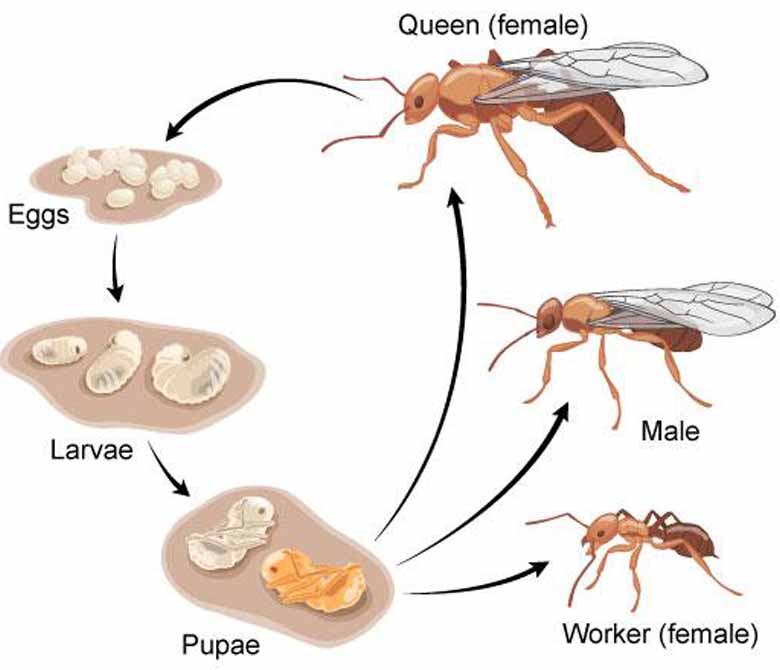
- Egg — looks like a tiny jelly bean.
- Larvae — looks like a long jelly bean.
- Pupae — when all body parts grow inside the larvae.
- Adult — sheds the "skin" to become an adult ant.
Treatment Strategy
Controlling ants
Inspect and locate colonies and trails before treating.
Interior Treatment
- Seal cracks and crevices.
- Spot treat entry points: windows, doors, crack and crevice applications.
- Baits are also effective immediately next to ant trails or where ants are foraging.
Exterior Treatment
- Treat colonies directly. Seal cracks and trim vegetation.
- Spot treat entry points and apply a perimeter treatment.
- Move infested wood at least 30 feet from the home, or discard it.
- Baits are also effective adjacent to the structure and immediately next to or on the ant trail itself.
Control tips for most ants
- Sweet, protein baits and non-repellents work best for most species of ants.
- Take "potential" aphid locations into account when treating for ants.
- Repellents can cause some species to bud, so non-repellents are a better choice.
- Bud = a process where a queen and accompanying workers leave the current nest and move to a new site to form a new colony.
- This means you can move an ant infestation from one area into multiple areas if the wrong product is chosen.
Got an ant problem?
We'll inspect your property and put together a targeted treatment plan that doesn't make the problem worse.
Request a quote